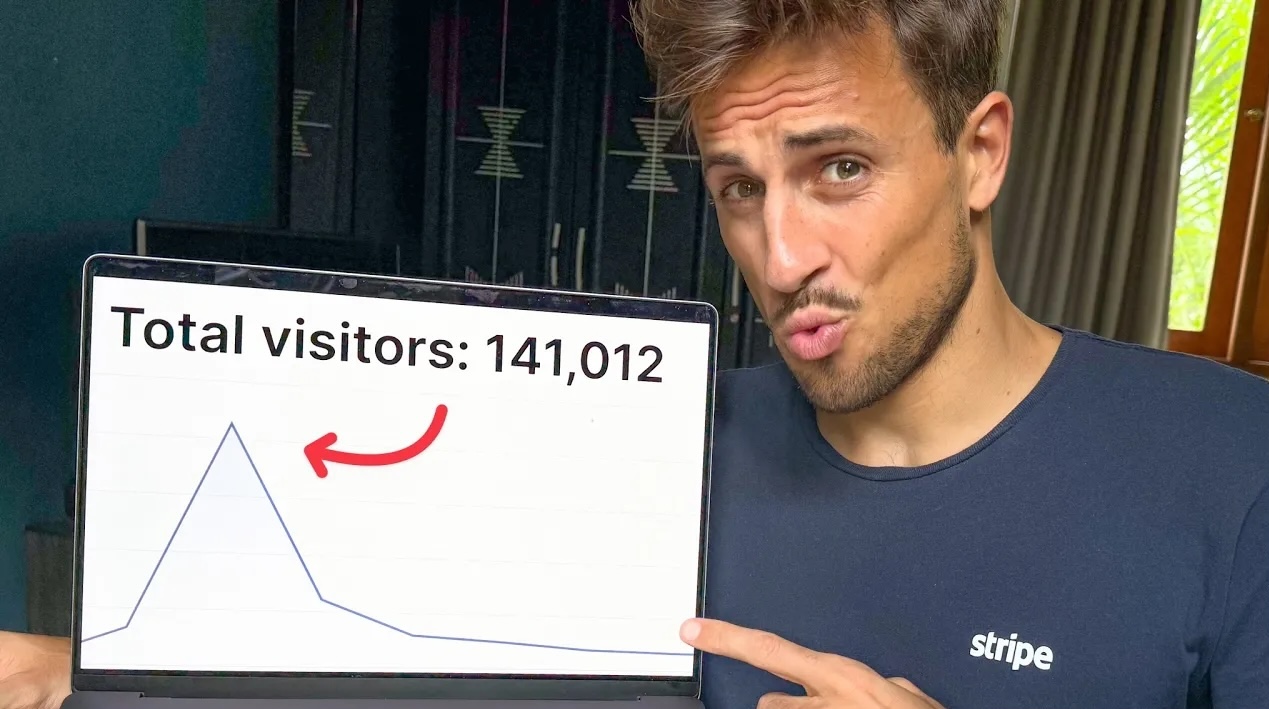
This is Marc's complete guide to launching on Product Hunt. I've broken it down so you can follow it step by step.
I recently went through this myself when I launched PythonStarter — a Flask starter kit for Python developers who want to launch their ideas faster.
Like most developers, my main focus was building the actual product. But getting anyone to see it - that's a different skill entirely.
In the article below, I'll outline what I learned studying the person who does this better than anyone.
Here's the original video this article is based on:
Who is Marc Lou and Why Should You Listen to Him?
In 2021, Marc Lou was living with his parents in France, depressed, newly married at age 30, with zero income.
Most of all, he felt like he hadn't achieved anything substantial in his life yet.
A tweet from perhaps the most famous indie maker of them all - Pieter Levels - changed everything. Marc moved to Bali, kept his costs low, and started shipping products.
Two years later he had built 21 products, won Product Hunt's Maker of the Year award in both 2023 and 2024, and crossed $1 million in lifetime revenue.
Today he makes over $100,000 a month from multiple products including TrustMMR, DataFast, ShipFast and many others.
He's not a VC-backed startup. He has no marketing team. He's one person who, through iterating and putting in the reps, has a system for launching on Product Hunt - and he's shared it publicly.
What is Product Hunt and Is It Worth It?
Product Hunt gets around 4 million visitors per month.
The quality of that traffic is unusually high - designers, programmers, agency owners, solopreneurs. People who actually buy software.
If you make the top product of the day:
- 2,000-3,000 visitors directly from the platform
- Extra thousands from being featured in the Product Hunt newsletter
- Ongoing spikes as other media sites pick up the listing
It's one of the best free distribution channels available for indie makers.
How Product Hunt Rankings Work
Every 24 hours, products compete for the most upvotes. The timer resets at midnight PST.
Key mechanics to understand:
- For the first 4 hours ranking is random. No winner-takes-all yet.
- After hour 5 products rank purely by upvotes.
- Once you're at the top it's much easier to stay there. Once you're at the bottom it's very hard to climb.
The first four hours are the most important window of your entire launch.
Part 1 - Inbound Upvotes: Winning the Home Feed
Inbound upvotes come from people already browsing Product Hunt who discover your listing organically.
The first 3 basics to get right are your name, your tagline, and your logo.
Product Name
Keep it short. Keep it simple. Make it logical.
Don't use abstract VC-style names like Stripe or Tesla. Use something that immediately tells a stranger what it does.
Marc's example: "DataFast" - a tool to get data analytics fast. Two words. Done.
Your Tagline
This is the most important line of text on your entire listing.
Rules:
- Maximum 60-70 characters. Product Hunt automatically limits this anyway.
- It should be about the problem you are solving for the customer.
- Don't describe what your product does. Describe what it does for them. What pain does it relieve? Why is it worth their time?
Bad tagline: "A project management tool with AI features"
Good tagline: "Stop losing track of tasks. Ship projects on time, every time."
Your Logo
Pick a colour that stands out. Scan the current Product Hunt homepage - if most logos are blue and white, go green. Go orange. Or even pink. The most important thing is that it stands out.
Being remarkable matters more than being polished.
Part 2 - Your Listing Page
If someone clicks through, the next two things matter most.
The Photo Carousel
You can upload up to 10 images. Only the first three get real attention.
Rules for each image:
- One image = one feature. No more.
- Zoom in. Show a tiny, close-up part of your UI - not a full dashboard.
- Use big headlines if you add text. Nobody reads small print in a screenshot.
Think billboard, not user manual.
A short eye-catching video is also good here. Product Hunt supports embedded YouTube and Loom videos.
The First Comment
This is your story - written by you, the founder, as the first comment on your own listing.
People relate to people, not companies. You're not a VC-backed startup with a marketing budget. You're an individual with a personal story who had a problem and built something.
Structure it like this:
- One bold line at the top - your hook
- Maximum 8 short paragraphs
- No paragraph longer than 2 sentences
- Bullet points where useful
- Links to your product, since the comment section supports markdown
- Your social links - Twitter, YouTube, wherever you're building in public
Marc is explicit about this: the comment section is one of the most underused parts of a Product Hunt launch. Don't skip it.
Part 3 - Outbound Upvotes: Driving Traffic From Outside
Outbound upvotes come from people who aren't on Product Hunt but come to vote for you.
1. Twitter / X
Product Hunt and Twitter share a huge audience overlap. Solopreneurs on Twitter have Product Hunt accounts and are happy to support launches.
Marc grew his early audience with creative launch videos - putting himself into fake podcasts with Joe Rogan, into movies with Leonardo DiCaprio. It was fun, it was shareable, and it converted viewers into upvoters.
You can directly ask your followers to upvote. That's allowed.
2. Your Existing Users
If you have users - even 50 - reach out to them directly.
Email them. Message them. Tell them you're launching today and you'd love their support. They already like your product. Most will help.
3. Your Personal Network
Family, friends, colleagues. Don't underestimate this. For a first launch it matters more than you'd expect.
What Day Should You Launch?
It depends on your goal.
- For maximum traffic - launch Monday to Friday. More people browsing, but more competition.
- For the best chance of winning an award badge - launch on Sunday. Least competition. VC-backed companies don't launch at midnight on Sundays.
If you want that badge to embed on your site, launch on a Sunday.
Are You Ready to Launch?
Marc's rule before going live is simple: you need social proof first.
At least a few testimonials on your site. A handful of real users. Something that shows a stranger the product is worth their time.
Why? Thousands of new people will discover you during a launch. If your site looks empty, most will leave.
The good news is that you can always relaunch. You can also launch free tools to promote your main product and build social proof before the big launch.
The Compound Effect Nobody Talks About
Let's be honest: your first launch probably won't go viral and start printing money like crazy.
Marc's first launch didn't go perfectly either.
Here's what actually happens when you keep launching:
- You launch -> a few people follow you on Twitter
- You build -> you launch again -> more followers
- Repeat -> your audience helps your next launch
- Bigger audience -> bigger next launch
It compounds. Each launch makes the next one easier. After a few launches, getting a Product Hunt badge becomes almost inevitable.
Marc puts it simply: "Just launch it. Keep repeating the same recipe over and over until luck finds you."
He went from zero income to $1M in just over two years. He didn't do it with funding or a team. He did it by shipping, launching, and compounding.
Summary Checklist
Before you go live, make sure you have:
- A short, logical product name, 2 words max
- A customer-focused tagline under 70 characters
- A logo that stands out on the homepage
- Zoomed-in carousel images, one feature each, ideally also a short video
- A personal founder story written as your first comment
- An outreach plan: Twitter post, user emails, personal network
- At least some social proof: testimonials, reviews
- A launch day chosen: Sunday for badge, Monday-Friday for traffic
I usually write about building web apps with Python and Flask. If you are a budding Python developer interested in using a starter kit to save time and build more products, check out PythonStarter — which I recently launched on Product Hunt myself.